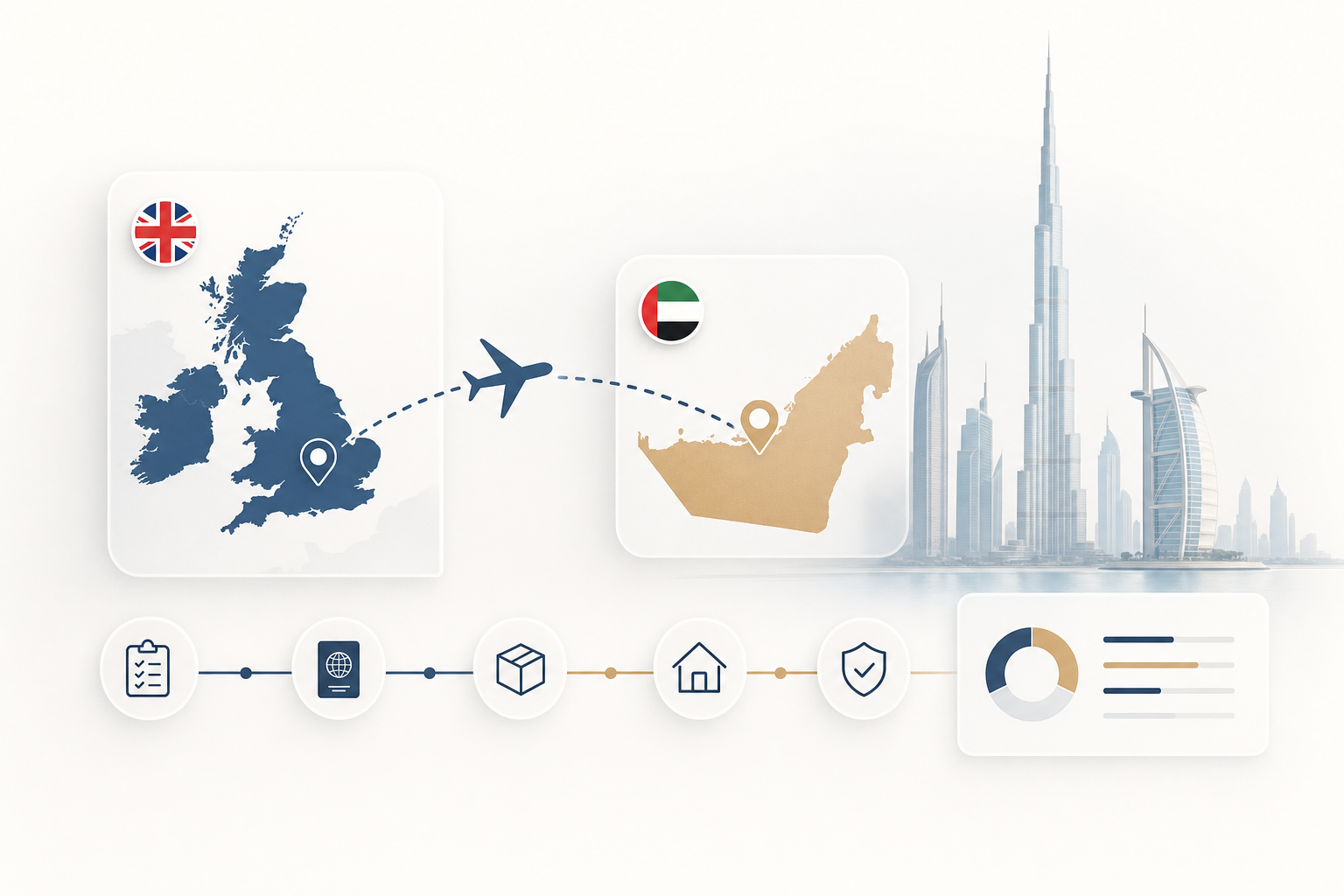
Moving personal belongings and setting up legal residency in the UAE requires coordinating between two distinct regulatory systems. While casual guides focus on sunny weather and zero income tax, an actual international relocation hinges on administrative precision. You have to navigate document legalisation, freight shipping times, customs inspections, medical checks, and formal UK tax departure.
Taking a structured approach prevents costly shipping delays at Jebel Ali port and avoids administrative hold-ups in Dubai. This guide lays out the chronological sequence to relocate from the UK to Dubai efficiently.
What to Prepare Before Leaving the UK
Relocation preparation begins at least three to four months before departure. The most critical early task is document attestation. UAE government entities and employers do not accept standard UK public documents unless they go through a specific three-tier validation process.
Start with the UK FCDO Legalisation Office service. You must submit original degree certificates, professional qualifications, marriage certificates, and children's birth certificates to the Foreign, Commonwealth & Development Office to receive an Apostille certificate. Once the FCDO verifies the documents, submit them to the UAE Embassy in London for consular attestation. After you arrive in Dubai, the Ministry of Foreign Affairs (MOFA) performs the final in-country verification stamp.
Check the expiry dates on all family passports. Dubai immigration requires a minimum of six months of passport validity upon entry, but twelve months or more is safer because your residence visa links directly to this document. If your passport expires shortly after your visa is issued, you will have to transfer the residency endorsement to a new passport, which creates extra paperwork.
Prospective expats often ask: is it worth moving to Dubai from the UK? The move provides obvious financial advantages through tax-free earnings and career growth, but upfront capital outlays are significant. Ensuring your paperwork is verified before leaving British soil protects you from having to courier documents back to London while living in temporary accommodation.
Phase 1: Secure Your Visa and Entry Permit
UK passport holders can enter the UAE on a standard 30-day visit visa issued free on arrival. However, entering as a tourist when you intend to take up immediate employment or settle permanently can complicate your status change. You should arrange your formal entry permit beforehand whenever possible.
Select the Correct Residency Pathway
The standard route is an employment visa sponsored by a mainland UAE company or a Free Zone entity. In this setup, your employer manages the initial entry permit application through the UAE ICP / GDRFA portal. Alternatively, experienced professionals, property investors purchasing real estate valued at 2 million AED or higher, and qualifying entrepreneurs can apply independently for a 10-Year Golden Visa or a 5-Year Green Visa, both of which eliminate the need for a corporate sponsor.
Pre-Entry Authorisation
Your sponsor issues an electronic Entry Permit (sometimes called an employment pink visa), which gives you 60 days to complete all remaining in-country residency formalities. Do not cancel your UK arrangements or board your flight until this digital document is approved on the ICP or GDRFA portal. You must also obtain basic health insurance that meets Dubai Health Authority (DHA) minimum standards before your residency process can conclude.
Phase 2: Arrange Shipping, Packing, and UAE Customs Clearance
Shipping household goods from the UK to the UAE is handled primarily via sea freight. Ocean transit from major UK container ports like Southampton, Felixstowe, or London Gateway to Jebel Ali in Dubai typically takes between 22 and 35 days on the water. Factoring in pre-carriage packing, export customs declarations, customs clearance at destination, and final delivery, allow eight to ten weeks for the entire door-to-door transit.
Decide whether you need a Full Container Load (FCL) or Less than Container Load (LCL). An FCL gives you exclusive use of a 20-foot or 40-foot steel container, which minimizes handling and accelerates port dispatch. LCL consolidates your items with other UK consignments into a shared container, reducing costs for smaller domestic volumes. If you require temporary storage while searching for a permanent villa or apartment, arrange storage services London facilities prior to port dispatch.
To ensure personal effects clear port without punitive tariffs, appoint a licensed specialist in international removals. Used household goods enter the UAE duty-free under personal effects exemptions. To secure this relief, you must submit your copy of the bill of lading, packing inventory, passport copy, and UAE entry permit or residence visa via the Dubai Customs personal effects declaration portal. If documents are missing, customs officers will assess a default 5% customs duty plus 5% VAT on the declared value of your shipment.
UAE customs enforces rigid contraband controls. Never pack pork products, religious literature contrary to Islamic values, counterfeit goods, or unapproved communication equipment. Electronic cigarettes and vapes face stringent scrutiny. Furthermore, any personal collection of wine, beer, or spirits requires a specialized import clearance permit; most movers recommend excluding alcohol from sea containers entirely to avoid protracted port inspections and container demurrage charges.
Phase 3: Complete Emirates ID and Residence Stamping
Once you land in Dubai using your entry permit, you enter the mandatory residency completion window. You cannot leave the country while this process is underway without invalidating your status.
Your first requirement is passing the medical fitness examination at an authorized DHA Medical Fitness Centre. Every expat aged 18 and older undergoes a blood test for communicable conditions, including HIV and Hepatitis B and C, along with a chest X-ray to check for pulmonary tuberculosis. Normal screening results return within 24 to 48 hours, though expedited four-hour VIP services are available at select clinics.
Following medical clearance, schedule an appointment at an ICP customer happiness centre for biometric enrollment. Officials capture your digital fingerprints, facial photograph, and iris scan. Once biometrics are completed and your residency is validated digitally by GDRFA, your physical Emirates ID card prints and ships via Emirates Post. The Emirates ID is mandatory: it serves as your universal identifier for opening accounts, signing contracts, activating internet lines, and accessing healthcare across the UAE.
Phase 4: Secure Housing, Ejari, and Utilities
With an Emirates ID in hand, you can move out of serviced accommodation and sign a residential tenancy agreement. Dubai's rental market functions on a cheque-based system where annual rent is paid in advance using one, two, four, or occasionally six post-dated cheques drawn on a local bank.
Calculate your living expenses carefully before committing to a lease. Financial planners in the region often refer to the 3000 rule in Dubai as a baseline budgeting benchmark, which suggests that an individual requires an absolute minimum of 3,000 AED per month just to cover core survival expenses—such as groceries, essential transport, and utilities—entirely separate from rental payments. Housing costs run significantly higher: a one-bedroom apartment in central Dubai typically rents for 70,000 to 110,000 AED annually.
Readers evaluating family affordability often ask: is $10,000 enough to live in Dubai? A household income of $10,000 per month (roughly 36,700 AED) provides a comfortable lifestyle for a family of three or four. This budget easily covers a modern three-bedroom townhouse in communities like Dubai Hills Estate or Arabian Ranches, private British curriculum schooling, utility bills, and running two family vehicles, while still leaving margin for monthly savings.
Once you sign your tenancy contract, register it immediately through Ejari, the government regulatory framework managed via the Dubai REST app. Registering the lease produces an official Ejari certificate, which proves your legal tenancy. DEWA (Dubai Electricity and Water Authority) connects automatically when your Ejari clears. You must pay a refundable utility security deposit (2,000 AED for apartments or 4,000 AED for villas) through the DEWA portal to turn on your power and water.
Phase 5: Finalise Banking and Notify HMRC
Operating solely on UK debit cards in the UAE creates ongoing foreign exchange fees and currency friction. As soon as you hold your Emirates ID and Ejari, visit a local branch—such as Emirates NBD, ADCB, or Mashreq—to open a current account. Bring your original passport, residency visa document, Emirates ID, a salary certificate from your employer, and your stamped tenancy agreement.
When negotiating employment contracts, British professionals regularly ask: is $20,000 a good salary in Dubai? An income of $20,000 per month equals roughly 73,400 AED. This level places an earner squarely in the top 5% of UAE wage earners. It affords high-end housing in prime waterfront districts, private education, frequent travel, and substantial capital accumulation, since zero local tax is deducted from your compensation.
Before closing your UK affairs, resolve your status with His Majesty's Revenue and Customs. File form P85 (Leaving the UK - getting your tax right) directly with HMRC. This form alerts the UK tax authority that you are moving abroad and allows them to adjust your tax code, issue any applicable PAYE refunds, and document your non-resident status under the UK Statutory Residence Test (SRT). Pay close attention to the SRT rules regarding visiting days to ensure you do not inadvertently trigger UK tax residency during trips back to visit relatives.
Mistakes That Delay UK-to-Dubai Moves
Relocating across borders involves stringent compliance standards. Small errors early in the process frequently lead to container retention charges, delayed employment onboarding, or administrative fines.
The most common failure is shipping personal belongings before securing document attestations. If your educational degree is not apostilled by the UK FCDO before leaving London, your UAE residency visa cannot be stamped under a skilled managerial or professional category. That delay freezes your ability to sign a tenancy contract, issue rent cheques, or obtain your local driving licence.
Another frequent misstep involves bringing controlled prescription medications into the UAE. Medications containing codeine, tramadol, or specific active ingredients used to treat ADHD and anxiety require pre-departure import permits issued through the Ministry of Health and Prevention (MOHAP) portal. Packing these in air luggage or sea containers without written approval risks border confiscation and legal interrogation.
Finally, underestimating initial cash flow requirements causes avoidable stress. Paying upfront real estate commissions (typically 5% plus VAT), annual rental deposits, DEWA connections, and customs clearances requires liquid cash before your first local salary clears. Partnering with a compliant overseas moving company ensures your customs inventory paperwork, bill of lading, and freight documentation are verified in advance, keeping your household goods moving smoothly from your UK address directly into your new Dubai home.